A service page ranks when it does one job: it matches one service to the exact thing a nearby buyer is searching for, then makes the next step obvious. That means one service, one primary keyword, real proof that you do the work, and a clear way to call or book. Get those four right and most of the “SEO” takes care of itself. Skip them and you end up with a page that looks nice and quietly does nothing.
This guide is for owners of local and multi-location businesses, medspas included, who want their service pages to bring in inquiries instead of just taking up space in the navigation menu.
TL;DR
- A service page explains one service (or one tightly related group) to a buyer who is close to hiring. Give each real service its own page.
- One page, one primary keyword. If two pages chase the same phrase, they compete with each other.
- Cover what is included, who it is for, why you are qualified, what happens next, and the questions people ask before booking.
- Use a unique title, a descriptive URL, clear headings and internal links with plain anchor text. Build location pages only when you can say something true and local on each.
- Expect weeks, not days, to judge results.
Table of Contents
- What a service page actually is
- Start with one service, one searcher, one next step
- What belongs on the page
- The on-page basics (title, URL, headings, links)
- When you need separate pages, and when you do not
- Local signals that help a service page
- A medspa example, section by section
- Common mistakes that sink service pages
- How long until you see results
- Our perspective
- Want us to build the pages for you?
- FAQ
- Sources
What a service page actually is
A service page is a page on your business website that describes and explains a signature service or offer to potential customers. It can cover a single service, several services under one umbrella, or everything you offer, though the more focused it is, the easier it is to match to a search.
Think of your homepage as the lobby and your service pages as the treatment rooms. Someone who types “laser hair removal” into Google does not want the lobby. They want the room where the thing they are shopping for happens.
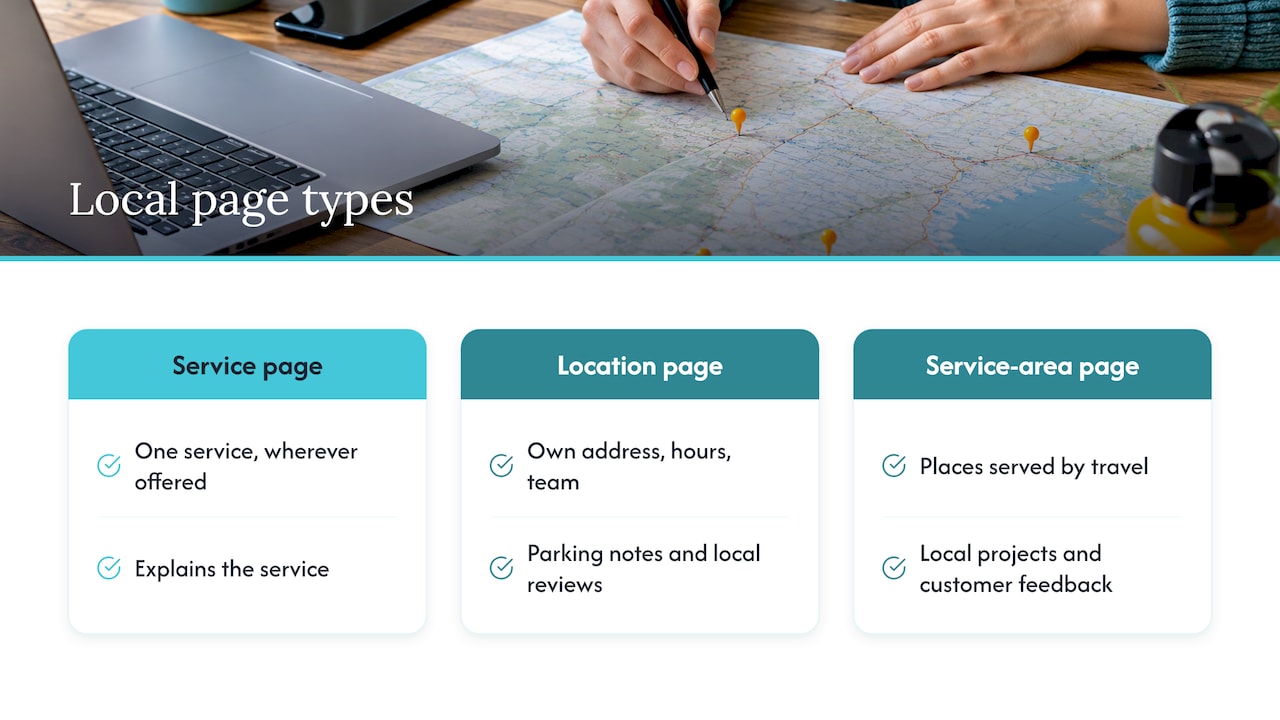
There are three page types people mix up:
- Service page: sells one service wherever you offer it. Example: “Botox injections.”
- Location page: represents a physical location, such as your second clinic across town.
- Service-area page: a landing page promoting the places a business travels to serve customers, as opposed to a storefront. Think plumbers, mobile notaries and delivery businesses.
Most medspas and single-location shops need service pages first. The other two come later, and only if they earn their place (more on that below).
Start with one service, one searcher, one next step
Before you write a word, answer three questions:
- Which actual service is this page about? Not a category, not a brand slogan. “Microneedling” beats “Skin rejuvenation solutions.”
- What phrase would a buyer type? Use their words, not the words on your price sheet or your supplier’s brochure.
- What do you want them to do? Call, book online, request a consult. Pick one primary action.
Then do two quick checks. Search the phrase yourself and see whether Google is showing service pages or articles. If the results are all guides and “what is” explainers, a sales page will struggle for that phrase. And search your own site: if you already have a page aimed at the same term, improve that one rather than adding a second.
Sort keywords by how close the searcher is to buying
A simple way to prioritize is by buying temperature:
- Ready to hire: “Botox near me,” “HVAC repair in Tucson,” “emergency plumber.” These belong on service pages with a phone number, the areas you cover and a booking button. Build these first.
- Comparing or pricing: “how much does CoolSculpting cost.” These suit a cost guide that links to the service page.
- Learning: “does laser hair removal hurt.” These suit blog posts or FAQs that link to the service page.
The mistake we see most often is stuffing all three intents onto one page. A page trying to be a service page, a cost guide and an encyclopedia entry ends up being mediocre at all three. Keep the service page about hiring, and let articles handle the rest. If you want to see how we think about writing for search engines and humans at once, our piece on writing web content that appeals to search engines goes deeper.
What belongs on the page
The most useful copy is long enough to answer real questions and structured so nobody has to read every word. That second part matters: one widely cited guide notes that 79% of users scan new web pages rather than read them, so headers, short lists and a visible call to action do real work.
Here is a build order that works for most local businesses.
1. A first screen that says what, where and for whom
The top of the page should tell a visitor, within a few seconds, what the service is, where you provide it and what to do next. “Microneedling in Tucson, AZ” with a short promise and a “Book a consult” button beats a stock photo and a vague tagline every time.
2. What is included
Describe the service in plain terms. What happens, how long it takes, what the visitor walks away with. For a medspa treatment, that means what a session involves, typical session length and what to expect afterward. Only state what is true for your practice.
3. Who it is for, and the problem it solves
Name the situation. “For clients dealing with fine lines around the eyes” speaks to a person. “For anyone seeking to enhance their appearance” speaks to nobody.
4. Why you are qualified
This is where proof lives: credentials of the people performing the service, years in practice, real photos of your space, real reviews, real before-and-afters where you have permission and the rules allow. Proof is the part competitors cannot copy by swapping a city name.
5. What happens next
Walk through the process: consultation, appointment, aftercare, follow-up. This lowers anxiety, and anxious visitors do not book.
6. Honest pricing guidance
You do not always have to publish a price list, but do not pretend cost does not matter. Explain what drives the price, offer a range if you can, or say how the quote works. Visitors who feel dodged leave.
7. FAQs
Use the questions your front desk answers every day. Answer them in two or three plain sentences. This is also where you pick up the longer, more conversational search phrases.
8. One clear call to action
Match the button to the buying step. A high-consideration treatment may need “Schedule a consultation”; a simple service may just need “Call now.” Repeat it at the top, middle and bottom, but do not offer six different options.
The on-page basics (title, URL, headings, links)
Google’s own SEO Starter Guide is refreshingly unmagical about this. Its advice boils down to a unique, clear and accurate title, a descriptive URL, logically organized related pages and links with understandable anchor text. In practice:
- Title: lead with the service and the place. “Microneedling in Tucson, AZ | Your Clinic Name” is clear. “Home” or “Services” is not.
- URL: short and readable, like /microneedling, not /service-page-3?id=482. We cover the details in how URLs affect your SEO.
- Headings: use them so a person (or someone using a screen reader) can follow the page. There is no magic number of headings that boosts rankings, so write them for readers.
- Internal links: link from your services overview to each service page, and from related pages and posts back to them, using anchors that say what the page is. “Learn about microneedling” beats “click here.”
On discovery, Google notes that it primarily finds pages through links from pages it already knows, and that a sitemap helps but is not required. So a service page that nothing links to is a service page nobody finds. Link it from your navigation and from related content.
When you need separate pages, and when you do not
Here is where local businesses get into trouble. The temptation is to build a page for every keyword variation: “Botox Tucson,” “Botox near me,” “Botox cost Tucson,” “best Botox Tucson.” Resist it. Separate pages make sense when they reflect meaningfully different services, locations or customer needs. Otherwise you create overlapping pages that compete and say the same thing.
Different services: yes
Lip filler and cheek filler involve different concerns, different questions and different pricing. Each can have its own page. If your medspa uses a procedure-versus-condition split, you can also have a page for the treatment and a separate page for the concern it addresses, with the condition page linking to the treatments.
Different places: only with real local substance
If you have one location, you probably only need service pages that mention where you are. If you have several locations, give each a location page with its own address, hours, team, parking notes and local reviews. For businesses that travel to customers, a service-area page needs evidence that you genuinely work there, such as local project examples and real customer feedback.
The classic failure is copying the service page, changing the town name and publishing twenty versions. Shared structure is fine. Shared substance is the trap: the pages become near-duplicates, and Google has little reason to prefer any of them.
A tidy way to picture it: the service page is the hub, explaining the service everywhere you offer it. Location or area pages branch off, each saying something true about that place, and link back up to the hub.
Local signals that help a service page
If the page is meant to bring in local customers, make it easy for Google to understand the business behind it.
- Consistent business details: name, address and phone number on the page should match your Google Business Profile and directory listings.
- Structured data: Google’s documentation explains that LocalBusiness markup can describe details such as hours and departments, and that results may show a knowledge panel or business carousel. It recommends using the most specific business subtype available, and the markup requires a business name and physical address. Only mark up content that visitors can actually see on the page.
- Local proof: reviews, photos of your actual space, mentions of neighborhoods you serve.
- Practical details: hours, parking, how to book, what to bring.
Our local optimization checklist and seven questions on local SEO walk through the profile and directory side in more detail.
A medspa example, section by section
Here is how a page for a single treatment might look. Swap in your own service and details.
| Page section | What to put there | Why it matters |
|---|---|---|
| Title and H1 | Treatment name plus city, such as “Microneedling in Tucson, AZ” | Matches the search and the page |
| Opening | Who it is for, what it addresses, a booking button | Answers the visitor in seconds |
| What to expect | Session length, steps, downtime, aftercare | Reduces anxiety, builds trust |
| Your providers | Names, credentials, photos | Shows why you are qualified |
| Results and reviews | Real client feedback, photos where permitted | Proof that cannot be faked by a template |
| Pricing guidance | What affects cost, how consults and quotes work | Honest answers keep visitors on the page |
| FAQs | Questions your front desk hears weekly | Captures longer search phrases |
| Related links | Links to complementary treatments and your contact page | Helps visitors and crawlers navigate |
One caution that is about safety, not SEO: medical and aesthetic treatments carry regulatory and advertising rules, and treatment details should be reviewed by the licensed clinician responsible for your practice before they go live. Keep medical claims accurate and consistent with what your providers will actually say in the room.
Common mistakes that sink service pages
- One mega-page for everything. A single “Services” page listing twenty treatments in two lines each cannot rank for twenty searches.
- Brochure language. “Premium, best-in-class solutions” says nothing. Specifics do.
- Hiding the next step. If a visitor has to hunt for the phone number, you lose them.
- Duplicate location pages. Same copy, different town. See above.
- Set and forget. Hours change, providers change, offers change. A stale page tells visitors (and Google) that nobody is home.
- Orphan pages. A page with no links pointing to it is hard to find, for people and crawlers alike.
How long until you see results
Google is candid here: some changes may take a few hours to show and others several months. Its advice is to wait a few weeks before judging whether a change helped, and it adds that not every change produces a noticeable impact. So publish, link to it, give it time, and review what the page is doing in Search Console and in your inquiry log. This is also why we describe SEO as an ongoing process rather than a one-time project.
A practical way to measure: track calls, form fills and bookings that start on the page, not just rankings. A page ranking fifth that books clients beats a page ranking second that does not.
Our perspective
Here is what we tell business owners when they ask whether service page SEO is worth the effort: it is the most direct line between a search and a booking, and it is also the easiest place to waste a year.
The waste usually comes from generic pages. A template with your logo on it looks fine and says what every competitor’s page says. We would rather understand your business goals and your audience first, then build pages around your actual services, your actual team and the customers you want more of. That is why we do not force generic packages or strategies on clients.
We also think service pages should not live on an island. They work best as part of a stepwise roadmap: a clean site, accurate Google Business Profile and directory listings, reviews that reflect how you treat people, and monthly reporting so you can see what is bringing in activity. When the pieces line up, a service page stops being a brochure and starts behaving like your best front-desk employee.
If you are a medspa or a multi-location business, the principle holds: say something true and specific about every service, in every place, and make the next step easy.
Lilly
Want us to build the pages for you?
If you would rather spend your week with clients than wrestling with titles, headings and markup, that is exactly what we do. Our team handles web design and SEO for local and multi-location businesses, including medspas, with solutions tailored to your goals instead of a generic package. Local visibility is part of the picture too, through our local SEO services, and if you are in the Tucson area, there is a page for Tucson local SEO.

To talk through which service pages your business needs first, start at anchorwave.com.
FAQ
What is a service page in SEO?
It is a page on your website that describes one service, or a tight group of related services, for someone close to hiring. It is built around a keyword that matches what a buyer would search, and it exists to turn that search into a call, booking or inquiry.
How do I rank a service page?
Choose one service and one primary keyword, then write a page that answers what is included, who it is for, why you are qualified and what happens next. Give it a clear title, a descriptive URL, internal links from related pages and a single obvious call to action. Then give it a few weeks before judging.
What is the difference between a service page and a location page?
A service page sells one service wherever you offer it. A location page represents a specific place, such as a clinic with its own address, hours and team. If you have a single location, service pages that mention your city are usually enough.
Should I make a page for every keyword variation?
No. “Botox Tucson” and “Botox near me” are the same buying decision, so they belong on one page. Create a separate page only when the service, the location or the customer need is genuinely different.
How long should a service page be?
Long enough to answer the questions a buyer has before booking, and no longer. For many services that is somewhere in the range of a few hundred to a thousand-plus words, organized with headings and short lists so it is easy to scan.
Sources
- How to create service pages that rank and convert (Search Engine Land)
- Service Area Pages: Boost Local SEO Across Locations (Search Engine Land)
- SEO Starter Guide: The Basics (Google Search Central)
- Local Business (LocalBusiness) Structured Data (Google Search Central)