
Search is changing.
For years, businesses have relied on Google, referrals, ads, social media, directories, email, networking, and their website to get found. Those things still matter. But now there is another way people are finding businesses: they’re asking AI.
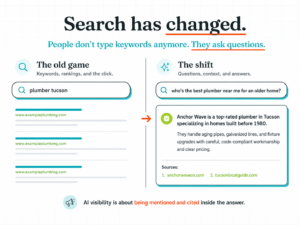
A potential customer might ask,
“Who’s the best company for [your service] near me?”
“Which company [in your industry] should I trust?”
“Who works with businesses like mine?” or
“What should I look for before choosing a company [in your industry]?”
Tools like AI Mode in Google Search, ChatGPT, Gemini, and Perplexity can help people narrow down their choices before they ever visit a website. That means your business could be recommended before someone has even heard your name. Or your competitor could be…
That is why AI Visibility is becoming an important part of your Lead Generation Engine.
But, it’s important to note, AI Visibility is not replacing SEO, your website, reviews, content, referrals, or the other ways you have invested in helping people find your business. It’s a new way for people to discover you. And discovery is only the first step to earning a customer.
What Does AI Visibility Mean?
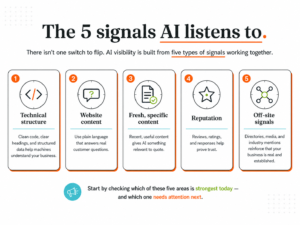
AI Visibility is how clearly AI tools can find, understand, and describe your business, so they can recommend you to searching potential customers. Can AI (and your customers) easily understand what you do, who you help, where you work, and what you are known for? Can they find enough information online to support what you say about your business?
That information does not come from one place. Your website matters, but AI tools may also find information about you through your Google Business Profile, reviews, directories, social media, local organizations, industry groups, articles, case studies, awards, and other websites.
All of those places help build a clearer picture of your business.
AI Is Changing How People Discover Businesses
Every lead has to start somewhere. Before someone can call you, fill out a form, schedule a meeting, or buy something, they have to know you exist. In the past, they may have found you because they searched Google, got a referral, saw an ad, met you at an event, or found you on social media.
Now, they may ask AI:
“Who are the best commercial roofers in Tucson?”
Or:
“What marketing agencies work with multi-location businesses in Arizona?” (Anchor Wave does!)
Instead of looking at ten companies one by one, searchers now ask AI to help narrow down the list. If your business shows up, great! You’re now part of their search. If you do not show up, they may never know you were even an option.
That why AI Visibility is so important to business. But being found is only the first step to getting the customer.
Being Found Is Only Step One
Imagine AI recommends your company. Great!
The person visits your website, but then they can’t quickly figure out what you do. Your main service is hard to find. Your message is unclear. There aren’t examples of your work. They’re not sure if you work with customers like them or businesses like theirs, and they don’t know what to do next on your website. So they leave.
AI did its job. It helped them find you. But your marketing still had work to do.
Your website needs to answer a few important questions quickly: Am I in the right place? Can this company help me? Can I trust them? What should I do next?
If you are spending time or money getting people to your website, you want that website to help turn those visits into real opportunities. Getting more people to a website that is confusing or hard to use could end up causing more harm to your brand than good.
That’s why we like to break the customer journey into four simple steps:
Discover
Can people find you?
Understand
Can they quickly tell what you do and if you can help them?
Trust
Can they find enough proof to feel confident in your business?
Take Action
Is it easy to know what they should do next to work with you?
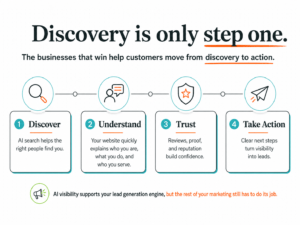
If one of those steps is skipped or unclear for the customer, you can lose the opportunity. AI Search isn’t a separate marketing task. Think of it as another tooth on your Lead Generation Engine gear. It works best when the other parts of your marketing are working with it.
AI Visibility Is Part of a Bigger System
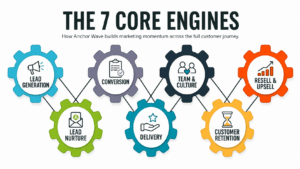
At Anchor Wave, we look at business as a connected system. We call it our 7 Core Business Engines Framework. Your Lead Generation Engine helps people find your business, and AI Search is another way that can happen. But once someone finds you, other parts of your marketing still need to work. Your website needs to explain what you do. Your content needs to show your knowledge. Your reviews and reputation need to build trust. Your website needs to make the next step easy. And your team still needs to follow up.
AI Visibility matters because discovery matters. But being visible is much more useful when the rest of your marketing is ready too.
Try This: A 15-Minute AI Visibility Check
You don’t need special software to start learning how AI sees your business. Open a few tabs, grab a notebook, and spend about 15 minutes checking these five things.
1. Search Like a Customer
Open ChatGPT, Gemini, Perplexity, or another AI Search tool. Don’t search your company name just yet.
Instead, ask the kinds of questions a customer might ask before they know who to hire:
- Who are the best [type of company] in [city]?
- What companies offer [specific service]?
- Who should I hire for [problem]?
- What should I look for when choosing a [provider]?
Then look at the results. Does your business show up? Which competitors show up? How are they described? Are there links or sources connected to the answer?
Don’t worry if you don’t appear every time. There isn’t a single AI ranking. You are looking for patterns.
2. Ask AI About Your Business
Now search your company by name. Ask what your business does, who it helps, what services it offers, where it works, and what it’s known for.
Then compare the answers with what is actually true. Look for missing services, old information, wrong locations, unclear descriptions, or important details that are missing.
This can show you the difference between what you know about your business and what the internet says about it.
3. Look at Your Website Like a New Visitor
This part can be hard because you already know your company inside and out. Try to look at your website like someone who has never heard of you. Within a few seconds, can you tell what the company does, who it helps, where it works, and what you should do next to work with them?
Then look deeper. Do your service pages answer common questions? Do you show examples of your work? Is your service area clear? Are your most important services easy to find?
A website can look great and still lose leads if people don’t understand what it’s saying or how to navigate it.
4. Look Beyond Your Website
Search your business name and look at what shows up besides your own website. You may see your Google Business Profile, reviews, Chamber listings, directories, social media, awards, articles, or other websites.
Ask yourself: Does all of this tell the same story? Does it tell the story I want my customers to read.
If your website says one thing, an old directory says something else, and your social media has old information, that can make your business harder to understand for AI search tools and customers alike. Also look at what’s missing. If you have an important service, award, skill, or area of expertise, is there anything online besides your website that supports it?
5. Look at Your Competitors
If competitors keep showing up where you don’t, take a closer look at them. Check their website, service pages, reviews, Google Business Profile, case studies, articles, directories, and other places they appear online.
You’re not looking for things to copy. You are looking for clues. What makes their business easy to understand? Then ask: What might be missing from mine?
Please Don’t Add “Do AI” to Your Marketing To-Do List
Marketing can already feel like a lot: SEO, social media, emails, ads, website updates, reviews, and content. And now, optimize for AI.
Good marketing shouldn’t feel like a giant pile of random tasks. The pieces should work together.
Your website explains what you do. Your content shows what you know. Your reviews build trust. Your business listings share correct information. Search helps people find you. Your website helps them take the next step.
AI Search is another place where all of those pieces can work together.
That’s why we look at marketing as a connected system instead of a list of separate tasks you have to keep up with.
Knowing What to Check Is One Thing. Knowing What to Fix First Is Another.
You can start checking your AI Visibility on your own, and we think you should. Run the searches. See what AI says. Look at your competitors. Check your website. Look at the rest of your online presence.
You may find a few things you can fix right away.
But at some point, the questions may get harder. Why are your competitors showing up instead of you? Which problems matter most? Is your website helping or hurting? Are your reviews, content, listings, and website working together? What should you fix first?
That’s where strategy matters.
Because the goal isn’t just to show up in ChatGPT or Google’s AI Overview.
The goal is to help the right people find you, understand you, trust you, and take action.
Want to Know Where You Stand?
Our free AI Visibility Report takes this check a few steps further.
Using our team’s experience and industry tools, we look at how your business is showing up in AI Search, which competitors may be showing up instead, the REAL prompts being asked inside search tools, where gaps may exist, and more importantly what is worth working on first.
We’re not going to hand you a pile of AI data and wish you luck. We want to help you understand where you stand, what matters, and what to do next.
Request your free AI Visibility Report and we’ll help you see what AI sees, where the gaps are, and how you can strengthen the path from discovery to customer.