
When the Oil Light Isn’t Just a Suggestion…
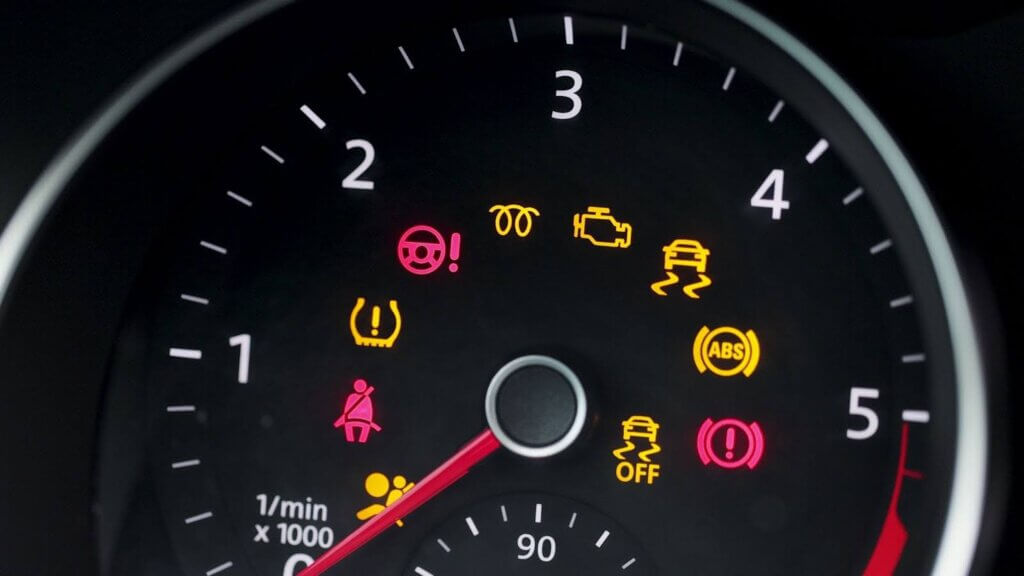
I used to own a Hyundai that taught me a lesson the hard way. You know that little red oil light that flicks on? I convinced myself it was just a gentle nudge. Like, “Hey friend, maybe consider topping me off sometime this month.”
So I ignored it. For a week…
Spoiler: the light wasn’t a suggestion. It was a screaming toddler on the dashboard. The kind that doesn’t stop until you do something. By the time I figured that out, I was standing on the side of the road staring at a burnt-out engine that had officially retired itself.

Now here’s the thing: I’m not telling you this because I want sympathy for my Hyundai (may she rest in peace). I’m telling you because business owners do the exact same thing every day. We see signals — slowing lead flow, sales cycles dragging on, a team that’s disengaged — and instead of treating them like urgent signals, we treat them like optional reminders, “I’ll get to it later.”
But here’s the twist: not every dashboard light is bad news. A full tank of gas? That’s momentum. Smooth RPMs? Efficiency. Even the dreaded oil light? That’s not failure — that’s information! And in business, the more clearly you can read your dashboard, the faster (and safer) you can scale.
That’s exactly what the 7 Core Engines Framework gives you: a dashboard for your entire business.
Blank Sheets, Laundry Lists, and Being Overwhelmed
Let’s rewind to the early days of running our agency. Every time we sat down to work on the business (not just in the business), we hit the same two walls:
- The Blank Sheet of Paper: Staring at nothing, waiting for genius to strike. Spoiler: it didn’t.
- The Endless Laundry List: Fifty problems, all screaming for attention. Which one actually matters? No clue…
Both lead to being overwhelmed. Both keep you spinning.
And both are primary reasons we created the 7 Core Engines Framework in the first place. Because clarity isn’t just about seeing what’s wrong — it’s about knowing where to start, what’s most urgent, and what will create the biggest domino effect!
When you stop guessing and start prioritizing, you move from scattered chaos to structured momentum. That’s when growth stops feeling like a shot in the dark and starts feeling like a predictable system.

The Power of Clarity
Here’s the uncomfortable truth: most businesses don’t fail because the leaders lack vision. They fail because the leaders drown in clutter.
We didn’t need more ideas. We needed to know which idea deserved attention first. That’s the brilliance of having a framework. It’s not just a list of things to “fix.” It’s a sequence. A set of levers that show you:
- Which signals are urgent vs. which are noise.
- Which system creates the most leverage.
- Where your business is weakest — and strongest.
And once you see that, everything changes. You can rally your team, focus your investments, and build from a place of strength instead of stress.
Systems > Goals
You’ve probably heard some version of this: “We don’t rise to the level of our goals. We fall to the level of our systems.” (James Clear, Atomic Habits)
It’s true. Goals sound inspiring — “We’ll double revenue this year!” But without the right systems… goals are just wishes in PowerPoint form.
The 7 Core Engines Framework is about building systems you can actually trust. Because when you know each engine in your business is humming along, you’re no longer starting every day at zero, you’re starting your day at 60%. So when opportunity comes knocking, you’re not scrambling. You’re already moving.
Introducing the 7 Core Engines
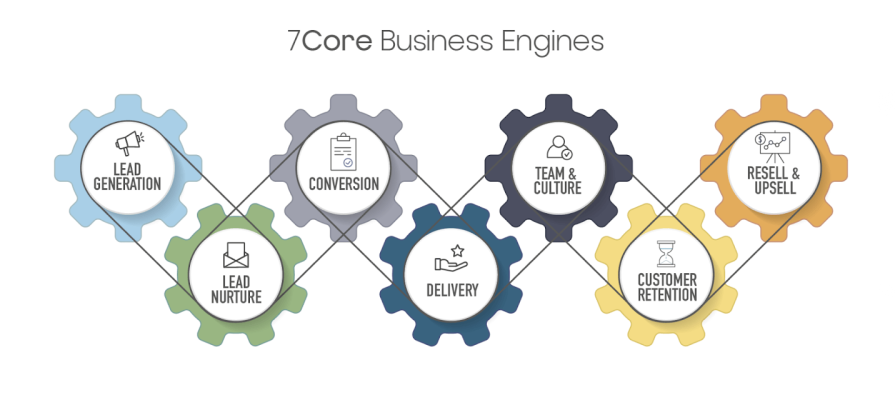
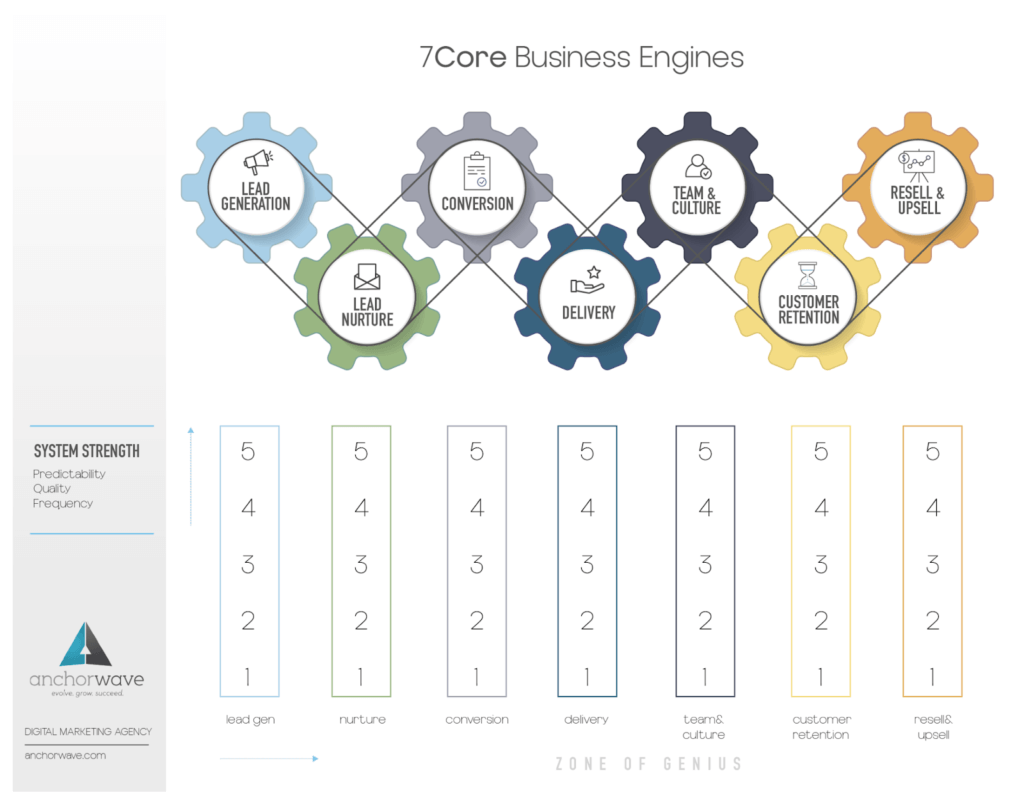
These engines may sound great, but you may be stuck asking: what’s a business engine anyway? We’re glad you asked! To us, a business engine is a large factor of your business which is fundamental to the running of your business. Every step of the process from a potential lead reaching out to you to delivering your products and/or services (and far beyond), is part of an engine. Think of each of them as a part of your business dashboard:
- Lead Generation – How you fuel the pipeline
- Lead Nurture – How you build trust until prospects are ready
- Conversion – How you close deals
- Delivery – How you fulfill with excellence
- Talent – The team that keeps it running
- Retention – How you keep clients coming back
- Resell/Upsell – How you increase lifetime value
On their own, each one is critical. But together? They give you a full dashboard, with signals that tell you exactly where to focus.
And remember — not all signals are bad. A pipeline full of warm leads? That’s a green light telling you to accelerate. A team running on all cylinders? That’s a sign you can push harder.
When you learn to read the dashboard, you stop guessing and start driving with confidence.
What Are the 7 Core Business Engines
Engine 1: Lead Generation
A lead is the foundation of a business’ growth and success. It does not matter how high quality your products and/or services are if no one is interested in them. And that is what a lead really is: expressed tangible interest from people who may become clients.
In the simplest terms, lead generation is attracting qualified leads, customer activity and is supported by brand awareness. The more attention your business is gaining and the more people who are showing interest (or a need for your business), the more opportunities for conversion in future engines.
Here are a few key takeaways from this engine:
- It Fuels Momentum — Leads keep your business in motion, creating the activity that powers every other engine.
- It Gives You Control — A predictable pipeline means you’re not stuck waiting for “word of mouth” luck.
- It Compounds — Ads, SEO, content, and networking all add fuel — and the more systems you layer, the smoother the ride.
Engine 2: Lead Nurture
Building and maintaining an engine to gather leads is an essential first step. However, once businesses gain that initial intro they drop the efforts to create trust in the way that an effectively overcomes skepticism. 96% of buyers need an additional 7 touchpoints before they make a decision, this is where many businesses drop the ball. The question becomes, how do you stand out and change this pattern? The answer: to nurture your leads, preparing them to convert and make a sale!
You can view the lead nurture engine as all the education, inspiration, timing, and repeated communication that generates enough trust to turn a lead into a prospect. When it comes to making a purchase — especially a pricey one — most people want to weigh their options. They want to see what sets you apart, what values your business has, what’s its reputation, and (for a lack of better words) who you are!
In basic terms: your customers need to feel safe, comfortable, and confident before committing to purchasing with you!
Engine 3: Conversion
Of all the 7 Core Engines, conversion may be the most exciting! After all your hard work of generating leads, then nurturing them with consistent communication and trust building, we’re at the moment where they decide to become a full-fledged customer.
While conversion can be viewed as the fruit of the first two engines, this too has potentials for growth opportunities. While some may come to a conversion — whether it be a point of sale or the signing of a contract — 100% ready to convert, there is always a potential that their trust is not fully in place, and they decide to not purchase.
If this is occurring, it may be a sign of the conversion engine not functioning properly. If you have sales people, do they have training frameworks to work from? Have you covered the ways to overcome potential lead objections, and properly tee up conversion conversations? The conversion engine should never be taken for granted, and could be a potential bottleneck that you weren’t even aware of!

Engine 4: Delivery
Congratulations, you’ve made a conversion! You’ve attracted a lead, nurtured their interest, and converted them to a customer. Great job! But we're only half way done here.
Just because you have a sale, does not mean systemizing won't help you become more profitable in the short and long term. In fact, the delivery — and the remaining engines — work to feed the cycle, building brand reputation and helping keep customers active and loyal!
Delivery is pretty simple to define: it’s what your business offers to your clients — or your products and/or services. If you’re an HVAC company, your delivery is the installation of a new A/C unit. Or if you’re a pizza joint, your delivery is the pizza (and maybe you’ll even deliver it too!). The delivery engine is based around highlighting what it is that your business does, and maintaining systems that keep that as high quality, cost-effective, and desirable to future leads and repeat customers.
While your business may be nothing like a pizza restaurant, the same core ideas ring true. To iron out any rough patches in your delivery engine and to optimize the benefits it is already offering you, you must create systems and checks which ensure consistent quality of deliverables, an experience-minded approach to customer service, and a pricing model which is profitable yet reasonable for what is standard in your industry!
Engine 5: Team & Culture
We’ve got a no duh! statement for you: a business is more than just the products/services it creates; it is a collection of individuals whose expertise and passion foster those products/services. Yes, it goes without saying that no company can function without the people it employs, but this engine plays a vital role in powering the success and longevity of your business, and must be given the same level of attention as the other core engines discussed today!
While all the engines work with each other, your team and culture play a vital role in every step of the process. Whether you are promising a high standard of product/service excellence, great customer satisfaction programs, or attention to detail, those promises are realized by the people you employ.
The key takeaways here are that:
- A strong team and business culture are what keep your business running.
- Your team and culture are how you make your promises of quality come to life!
Engine 6: Customer Loyalty
No customer is just a one time opportunity. No matter how niche, esoteric, or uncommon your business is, your customers can continue to be advocates to your business’ quality for life. This is a key tenet of the customer loyalty engine, which specializes in the propensity and availability of recurring revenue, stickiness, and loyal experiences with your brand.
Not only do recurring customers offer an ongoing revenue stream, but their true power lies in their ability to raise your business’ brand reputation. By leaving authentic and glowing reviews, following and sharing your social media content, and declaring your quality to their friends and family, loyal customers chose to recommend you to their peers out of pure satisfaction. This means that as their lifetime value increases, so do the leads which they add back into your lead generation engine.
If you are reviewing your clients and noticing that many are not coming back, purchasing a secondary product or service, or if you don't have a continuity product in place, then there could be some key issues in this engine.
Engine 7: Resell & Upsell
We just covered customer loyalty, so how is the resell and upsell engine different? While there is some overlap between the two, the resell and upsell engine is focused more around increasing repetition and additions for existing customers.
As mentioned above, a loyal customer will go out of their way to grow your brand reputation and provide you with leads. But it is essential to show the same level of enthusiasm back towards those same repeat customers. Reselling and upselling allows you to grow relationships with your clients, as you expose them to new/updated/enhanced versions of your products and/or services, building trust as you go.
All the other engines build up to this one, and they all work in tandem to support it. However, even this late into the 7 Core Engines, the resell and upsell engine has the potential to be stifling your business out of a prime opportunity to expand sales and customer enthusiasm. And conversely, this engine is a place to leverage opportunities with your clients, growing the successes you have already achieved in this space.
Scoring Your Business’ Success
So that is the 7 Core Business Engines! We’re extremely excited for how they can benefit local businesses, and their ability to understand on a deeper level how their businesses are working under the hood. They give clarity to some of the more murky aspects of running a business, and help move you past that blank sheet and into real, actionable solutions!
However, just knowing the engines isn’t enough; you have to understand how you can gauge success in each, as well as know where to direct your focus first. That’s why we’ve created a scoring methodology to assist. This should help you be able to put a numeric score to the very large questions being asked.
When analyzing each engine in your business, let's anchor in on that quote by James Clear. If success is measured by falling to the level of your systems — where in your business do you already have reliable and repeatable practices in place to handle the work? A ‘system' that runs without your constant attention.
You should keep the following outcomes in mind:
- Predictability: How well are you able to predict the results of an engine? Do the results of this engine feel random, or are they consistent and measurable?
- Quality: What is the quality of the results you find in this engine? Are the results frequently satisfactory, or are you often disappointed by the results of this engine?
- Frequency: At what frequency are you receiving results for this engine? Do you have a steady flow of positive results, or are they few and far between?
Using these questions, you can begin to rate each engine (going in the order they have been presented in this blog) between 1 and 5.
If you’re still having issues rating the success of each engine, maybe some additional questions could help. Imagine what if scenarios for each engine, questioning how they would respond to an absence, or some other change factor. For instance, would your conversion engine not work as well if your best performing sales person was sick for two weeks? Questions like this reveal the processes, checklists, and repeatable steps you already have built into your business, and where you are still lacking them!
In this search, you’ll more than likely find areas that run best probably already have processes, checklists, and repeatable steps that help them run without constant oversight. And that’s a great thing; that’s what systems do for your business! These systems are the base of function in each engine, and are why you don’t have to start from scratch every day.
Alright, so let’s have a gut check: go ahead and rate each engine. We’ve put together a graphic you can use!
Prioritizing For Success
We’re sure that scoring each engine was an eye-opening experience (that’s good, it’s supposed to be)! Now that possible bottlenecks have been identified — as well as existing processes and areas of success — you can move into the process of addressing each engine individually.
But don’t just jump in all willy-nilly! The engines have been laid out in a particular order because they function linearly. If you have no leads being generated, then how can you address converting clients?
Addressing engines from left to right is essential to get the most out of the 7 Core Business Engines, as each engine builds on the one before it. That’s why the graphic above has each engine as a gear with a line between them; like a Swiss made watch, each engine acts as a gear in the larger machine of your business! The better they work, the better the whole business does!
Anchor Wave’s 7 Core Business Engines
We created the 7 Core Business Engines because we know the difficulty of being a local business owner. It can feel tough to see any negative (or positive) signs of how your business is performing until your business is metaphorically on the side of the road with a smoking engine.
There are countless things that need to be done on a daily basis, and just pushing that ignition button may feel almost impossible. And that is the true power of the 7 Core Engines; giving you the incremental tools to get on the road and into the fast lane!

So why not trust the creators? The 7 Core Business Engines is an exciting framework by us at Anchor Wave, based on our decades of experience in brand reputation building! In the realms of digital marketing and web design, we’ve helped countless businesses find their voice, grow their client list, and stay competitive online. Our team of experts are always researching and adapting to the quickly changing spaces of digital marketing, and want to help your business find new and innovative ways to reach your target audience.
If you’re interested in harnessing the 7 Core Business Engines to their fullest, then we can help you get the best understanding of each of your engines as possible, identifying areas to celebrate and areas in need of improvement through proprietary and objective tools. Contact us today for a complete diagnostic, or to learn more about how we can help your business succeed!